
You See a Bag. I See Weeks of Work: Why Handmade Designer Bags Cost What They Do
Someone sees a bag and asks: Why does it cost so much?
I see the idea that arrived before the bag existed. I see the sketches, calculations, pattern development, leather selection, construction decisions, failed attempts, corrections, hours of handwork, and the person whose knowledge transformed a flat piece of material into an object with shape, purpose, and identity.
The customer sees the finished piece. The designer remembers everything it took to bring that piece into the world.
This is not written to convince everyone that they should buy a handmade designer bag. Luxury, beauty, and value are personal. What feels meaningful to one person may not matter to another, and everyone has the right to decide where they want to spend their money.
But there is a difference between saying, “This is not where I choose to invest,” and believing that a handmade designer object has no reason to cost what it costs.
It has a reason. In fact, it has many.
The Price Does Not Begin With the Leather
People often assume that the price of a bag should be calculated by looking at the visible material and estimating how much that material may have cost. But the price does not begin with the leather.
It begins with an idea.
As designers, we do not always sit at a desk and decide that between two and four in the afternoon we will invent something original. Ideas rarely behave according to a schedule. They can arrive while walking through a city, observing architecture, looking at the movement of fabric, traveling, speaking to someone, or noticing the shape of an object that has nothing to do with fashion.
Sometimes an idea appears as a complete image. Sometimes it begins with one curve, one transformation, or one question: What if a bag could be worn differently? What if its shape could change? What if it could function as both an everyday object and a sculptural statement?
That first moment may look effortless, but it is supported by years of experience.
A designer does not see only a beautiful image. We immediately begin to imagine how that image could exist in three dimensions. How would it relate to the body? Who would carry it? Where would it be worn? What would it need to hold? How would it open? How would its weight be distributed? Could the idea actually be constructed?
The inspiration may arrive in a second.
Turning it into a real object can take weeks, months, and sometimes much longer.
An Idea Must Become a Complete World
Once the initial idea appears, it has to be defined.
Before production begins, I build an entire atmosphere around the piece. I imagine the person carrying it, her movement, her clothing, her lifestyle, and the moment in which the bag exists.
Even when there is no physical mood board in front of me, one begins to develop in my mind.
I have to understand whether the bag should feel structured or soft, quiet or expressive, minimal or sculptural. I consider how it will sit against the body and whether it will be carried by hand, on the shoulder, under the arm, across the body, or in several different ways.
For multifunctional designs, the process becomes even more complex. Every transformation has to make sense. The position of the handles, straps, chains, zippers, pockets, closures, and logo must work in every version of the bag.
A transformable bag cannot look complete in one form and accidental in another. Each way of wearing it must feel intentional.
At this stage, I am already making dozens of decisions that will never be visible as separate elements in the final price. But without them, the final product would not exist.
Design is not only the moment of inspiration.
Design is every decision that follows it.
Then Comes the Search for the Right Leather
When the concept and construction direction are clear, the search for material begins.
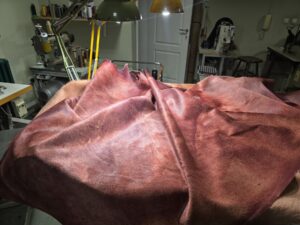
At UniUkiyo, leather is not selected only because a certain color looks beautiful. It must be right for the particular design.
I consider its origin, quality, thickness, weight, flexibility, strength, texture, finish, and the way it responds to movement. I need to know whether it can support the intended structure, whether it can fold in the necessary way, whether it will hold a sculptural form, and how it will behave once the bag begins to carry weight.
A soft oversized bag requires a different leather from a structured business bag. A transformable piece needs leather that can move without losing its integrity. A bag with rounded construction may require completely different characteristics from one based on sharp geometric lines.
Even two hides that appear similar at first glance can behave differently when cut, stitched, folded, or placed under tension.
The leather used for the exterior must also work with the interior, reinforcement, hardware, and construction technique. UniUkiyo bags are developed with leather throughout the design, including leather interiors, which adds another level of material selection, precision, and workmanship.
Then there are the smaller elements: zippers, chains, clasps, rings, magnets, buckles, reinforcement materials, thread, and every component required to make the design function.
When producing in small quantities, these materials are not purchased by the tens of thousands at the lowest possible industrial price. They are sourced specifically for a limited number of pieces or, in some cases, for one individual bag.
Small production changes the economics of every component.
But it also allows every component to be chosen with greater intention.
Before the Bag Can Be Made, Its Pattern Must Be Invented
A new design does not arrive with an existing pattern.
The pattern has to be created.
This is one of the most demanding and least understood parts of the process. A drawing can suggest the shape of a bag, but a pattern determines whether that shape can exist.
Every line, curve, seam, fold, allowance, opening, attachment point, and connection between parts has to be calculated. The designer and pattern maker must translate a three-dimensional idea into flat pieces that will eventually return to three dimensions when assembled.
This work requires time, concentration, experience, and an almost architectural way of thinking.
A few millimeters can change the final balance. A curve that appears beautiful on paper may behave differently in leather. A handle may need reinforcement that was not visible in the original sketch. A closure may affect the structure around it. A multifunctional detail may require several rounds of testing before it moves naturally.
Pattern making is quiet work. It demands complete attention because every centimeter has consequences.
Sometimes the first pattern works beautifully. Often it needs to be adjusted. A prototype may reveal that a proportion should change, that one section requires more support, or that a transformation needs to become simpler for the wearer.
Those trials are part of the design process.
They require material, labor, knowledge, and time—even when they never become a product that can be sold.
When you purchase the final bag, you are not paying only for the successful final pattern.
You are also paying for everything that had to be learned before that pattern became possible.
Handmade Does Not Mean Made Without Tools
There is sometimes confusion around the phrase “handmade.”
A handmade leather bag may still require professional sewing machines, cutting tools, presses, specialized equipment, and other instruments. Handmade does not mean that every seam is necessarily sewn with a needle held directly in the hand.
It means that a person—not an automated production line—guides the process.
A human hand positions the pattern, examines the leather, chooses where each piece should be cut, controls the machine, aligns the seams, attaches the details, checks the tension, shapes the material, finishes the edges, and makes decisions throughout the construction.
Machines are tools.
They do not replace the knowledge of the person using them.
In small-scale production, one artisan may be responsible for almost the entire bag. In a slightly larger workshop, two or more people may contribute their specialist skills. Either way, the process remains direct, attentive, and human.
The leather is not placed at one end of a machine so that a completed bag can emerge from the other.
Every stage requires someone to know exactly what comes next—and why.
The Construction Begins Long Before the Large Pieces Are Joined
People often imagine that making a bag means cutting the front and back, sewing them together, adding handles, and finishing the work.
The real sequence is much more complex.
Depending on the construction, work may begin with the smallest details. Pockets, straps, handle components, tabs, closures, reinforcement pieces, decorative elements, and logo placement may all need to be completed before they can be attached to the larger sections.
The leather is inspected and positioned before it is cut. Every piece must be oriented correctly. Areas exposed to weight and tension must be reinforced. Parts that will later become inaccessible must be finished before the main body is assembled.
The interior has its own construction process. The exterior has another. Only when the individual elements are ready can the larger parts begin to come together.
Then the bag must be shaped, balanced, examined, cleaned, and finished.
At every stage, one mistake can affect everything that follows.
This is why handmade production cannot be rushed without consequences. The work demands patience, precision, and respect for the order of construction.
Depending on the complexity of the design, producing one bag can take from approximately one week to two or three weeks. A particularly complex new model, customized piece, or first production may require even more time.
That time is not an inefficiency.
That time is part of the quality.
You Are Not Paying Only for Hours
Even after all of this is explained, people sometimes calculate the visible working hours and ask whether the price should still be lower.
But expertise cannot be valued only by counting the hours spent on the final object.
A skilled artisan may complete a particular detail in two hours because they spent twenty years learning how to do it correctly. A designer may resolve a construction problem quickly because years of previous work taught them where the problem would occur.
You are not paying only for the hour.
You are paying for the knowledge inside that hour.
The price also carries the years required to develop a design language, understand materials, recognize proportion, build patterns, solve structural problems, and create something original rather than reproduce an object that already exists.
A handmade designer bag contains visible labor and invisible experience.
Both have value.
A Famous Name Is Not the Same as Real Value
One of the questions independent designers hear most often is: Why is this bag expensive if the brand is not globally famous?
But fame and value are not the same thing.
A famous name may increase desirability, recognition, collectability, and price. That is part of the luxury market. But the absence of global fame does not make the leather less valuable, the construction less demanding, the artisan’s hands less skilled, or the designer’s idea less original.
Craftsmanship exists before recognition.
Innovation exists before popularity.
Every established design house was once unknown. The quality of its early work did not begin only after the world learned its name.
When you buy from an independent designer, you may not be paying for thousands of stores, enormous advertising campaigns, celebrity contracts, or decades of global brand recognition. But you are paying for something else: direct creative authorship, small-scale production, unusual design, personal involvement, and an object that has not been made for everyone.
A lesser-known name does not automatically mean a lesser object.
Sometimes it means you discovered the work before the rest of the world did.
We Understand Value Differently in Other Parts of Life
When we order a meal in a restaurant, we rarely expect the price to equal only the cost of the raw ingredients.
We understand that we are paying for the chef’s knowledge, preparation, time, staff, space, presentation, atmosphere, and the complete experience. The ingredients may be consumed in an hour, yet we accept that their transformation has value.
Fashion is often judged differently.
Someone may look at a leather bag and ask only how much the leather cost. The design, pattern development, construction, labor, originality, and years of experience disappear from the calculation.
We are free to spend money on whichever experiences or objects bring meaning to our lives. For one person, that may be travel. For another, food, art, technology, interiors, jewelry, or fashion.
The point is not that one choice is better than another.
The point is that value is never defined only by raw material.
It is created through transformation.
You Are Buying More Than an Object
When you purchase a handmade designer bag, you are buying a functional object—but you are not buying only function.
You are buying an idea that did not exist before someone imagined it.
You are buying the designer’s point of view. You are buying the knowledge required to transform that vision into a pattern, and the skill required to transform the pattern into a physical form.
You are buying carefully selected material, human labor, time, precision, and rarity.
You are buying a piece that was touched, examined, and guided through every stage by real people.
You are buying something that has not been produced in hundreds of thousands of identical copies. In the case of a customized or limited-edition piece, you may be purchasing a combination that belongs only to you.
You are buying a statement.
You are buying a story.
You are buying an emotion.
And yes, you are buying part of the heart and soul that went into creating it.
That may sound romantic, but for a designer, it is literal. Creative work does not happen at a distance from the person making it. We place our energy, attention, bodies, experience, uncertainty, and belief into the process.
The final bag is physical evidence of all of it.
Price and Value Are Not the Same Thing
Price is a number.
Value is everything contained within it.
Not every expensive object has true value, and not every inexpensive object is without quality. Price alone cannot tell the complete story.
But when a handmade designer bag is priced responsibly, that number reflects the reality of making it: the concept, development, materials, pattern, prototypes, skilled labor, tools, production time, small quantities, and the possibility that the designer and maker can continue creating without devaluing their own work.
If a price covers only the leather and a fraction of the labor, the product may still exist—but the people behind it cannot continue.
Creative work deserves to be sustainable not only as an environmental idea, but as a human one.
The artisan must be paid.
The designer must be paid.
The knowledge, time, and physical work must be respected.
A price that ignores those things is not more honest. It simply transfers the cost to the person whose work has been undervalued.
Not Everyone Needs to Buy It—and That Is the Point
A handmade statement bag is not created for everyone.
That is not arrogance. It is the nature of individual design.
Some people want an accessible bag that serves a temporary need. Others want a recognizable logo. Some follow a seasonal trend, while others search for an object they will keep, wear repeatedly, and connect with personally.
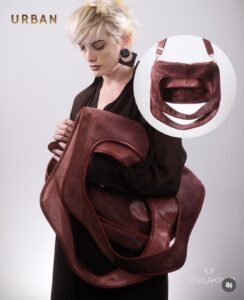
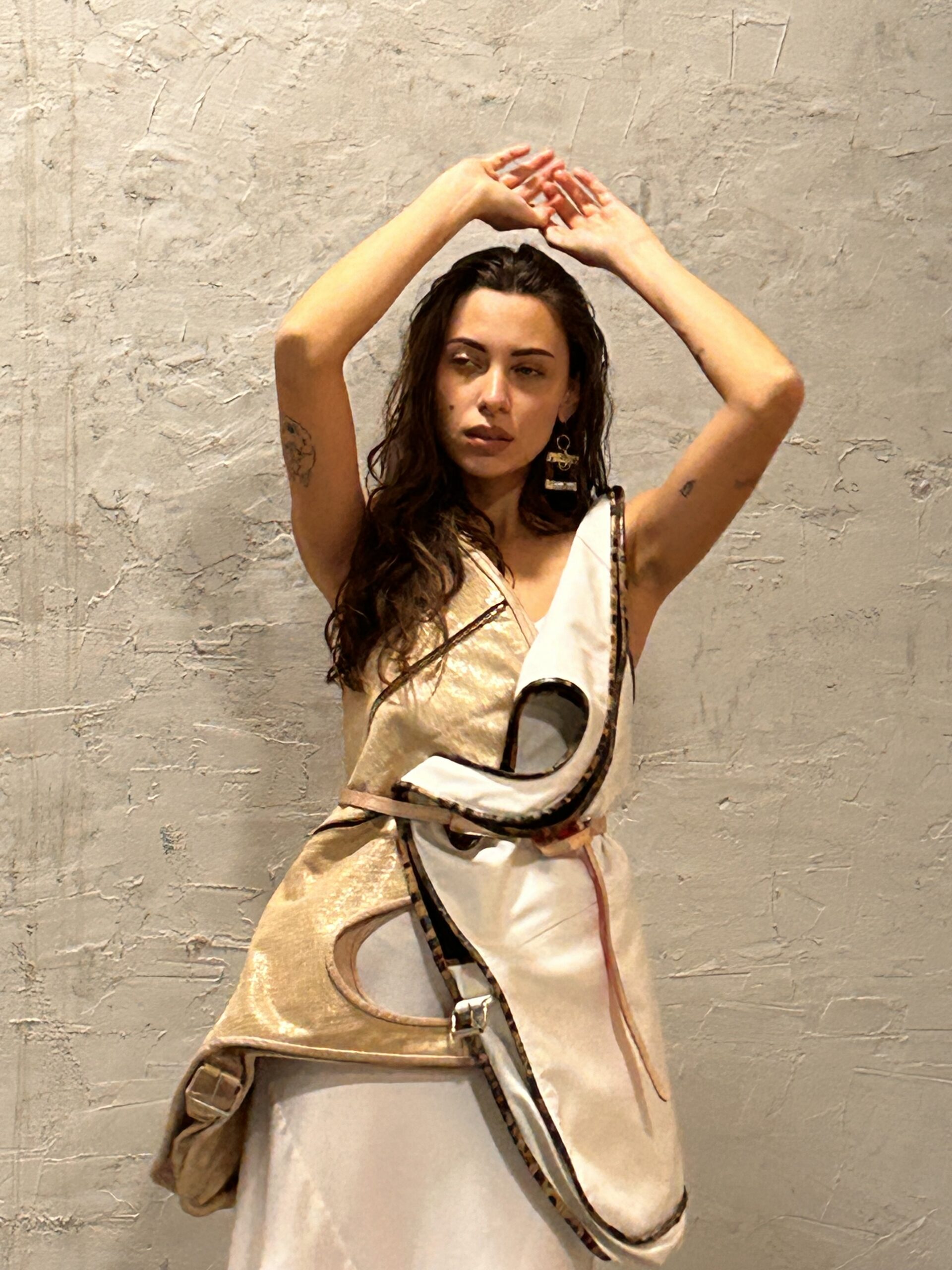
A UniUkiyo bag is created for someone who sees value in originality, transformation, material, craftsmanship, and a design that does not look like everything else.
It is for someone who understands that rarity is not only about how many pieces exist. It is also about how rarely this level of attention is still given to one object.
You do not have to want that.
But if you do, you are not simply buying a bag.
You are choosing to preserve an idea, a skill, a craft, and an independent creative voice.
The Final Price Is Only the Last Part of the Story
When you see the price of a handmade designer bag, you are looking at the final number in a story whose beginning you did not witness.
You did not see the moment the idea arrived.
You did not see the first drawing, the imagined woman, the mood, or the decisions that gradually gave the design its identity.
You did not see the search for the right leather, the calculation of every curve, the creation of a pattern that had never existed, the pieces that had to be cut again, or the hours spent resolving a detail that should look effortless in the finished bag.
You did not see the artisan’s hands, the concentration, the physical work, or the days and weeks during which the object slowly became complete.
You see a bag.
I see the idea, the risk, the knowledge, the hands, the time, the heart, and the life inside it.
That is what the price represents.
And that is why handmade designer pieces cost what they do.